
Power, gas crisis cannot be solved through long marches: PM
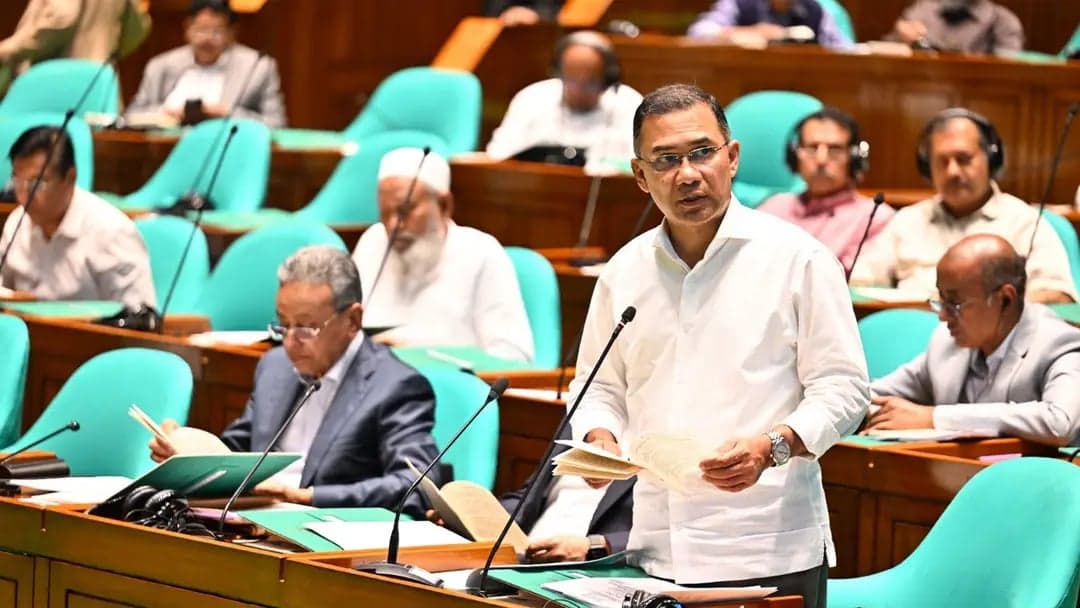

In his closing speech at the third session of the National Parliament, Prime Minister and Leader of the House Tarique Rahman called upon the people to be patient in tackling the gas and power crisis caused by the fragile economy left behind by fascism, the recent war situation in the Middle East, and an unwanted accident at one of the two LNG terminals.
Strongly criticising the long march programmes organised by opposition parties at this critical juncture, he said they should stand by the government in overcoming the crisis instead of exploiting people's suffering to incite them. If the crisis could be solved through long marches, the ruling party would have organised them first, he said. Referring to the opposition as an important part of the government, he expressed his determination to make the National Parliament the focal point of all discussions. At the same time, he announced major steps towards solar power generation for a permanent solution to the gas and power problem, and expressed firm hope of overcoming the current situation quickly, recalling the BNP government's past successes and track record of overcoming crises.
The Prime Minister made these remarks in his closing speech at the third session of the 13th Parliament on Thursday, September 10, with Speaker Hafiz Uddin Ahmed in the chair.
At the beginning of his speech, the Prime Minister paid deep respect to the martyrs of the great Liberation War of 1971 and the bloody July uprising two years ago. He said the third session of the National Parliament is ending today through a historic mass uprising. Although the session was brief, both sides held effective discussions on various problems and potentials of the country and the nation. While he did not claim that every discussion in parliament was entirely meaningful, he expressed his interest in making parliament the central focal point of all national discussions.
Praising the goodwill of all MPs, the Prime Minister said there is no doubt that both sides made sincere efforts to work in the interest of the country and its people. The government has been working tirelessly since its first day in office to fulfil the dreams of those who sacrificed their lives, were injured or suffered in the struggle to establish democracy up to the 2024 movement, and to ensure the safety of ordinary people.
Recalling the context behind running the state and the election pledges, the Prime Minister said the people voted in favour of BNP's election manifesto in the February 12 election and entrusted the party with the responsibility of running the country. Believing that the opposition is also part of the government in a democratic system, he expressed his intention to work for public welfare together with the opposition. Since taking office on February 17, every promise made to the people is being implemented in phases. At the time of assuming office, corruption had piled up in nearly every sector, including power, energy, industries, education and banking, due to the past fascist rule, which is known to all, including the opposition and the media. He assured parliament that the government is taking effective steps through a specific plan, without using these inherited problems as an excuse.
Explaining in detail the reasons behind the recent severe gas and power crisis, the Prime Minister said this crisis did not arise suddenly. For more than a decade, the fascist government made no effort to extract gas from domestic sources. Even when neighbouring countries were extracting gas in the Bay of Bengal, an invisible signal stopped Bangladesh from drilling gas wells in its territory, so that a particular country could benefit. Subsequently, the country became completely dependent on importing fuel from the Middle East. But just 10 to 12 days after the current government was formed, a war situation began in the Middle East, creating a major obstacle to oil and gas imports. Alongside this, an accident caused by an electrical shock at one of the country's two LNG terminals (FSRUs) left it completely inoperable, pushing the crisis to an extreme level.
In this difficult situation of the energy crisis, the Prime Minister questioned the opposition's responsible role. Strongly criticising the opposition's long march programme with a huge motorcade, he said it is not appropriate to make any futile attempt by exploiting people's suffering or unnecessarily provoking them. If long marches of vehicles could solve the gas or power problem, the government itself would have organised them first.
Recalling the previous government's changes to office schedules, reduced banking hours and extra school holidays during the Russia-Ukraine war in 2022, he said the then government had bankrupted and indebted the state by setting up quick rental power plants in the name of ensuring electricity, without providing a long-term solution. If the situation created by the Middle East war and technical disasters amid the ongoing Ukraine war is turned into provocative behaviour, it would undermine the sacrifices of the 1,400 martyrs and 30,000 affected people who gave their lives in past movements and struggles, and the defeated and ousted fascist clique would benefit.
Informing parliament of the plan and hope for overcoming the crisis, the Prime Minister said the government has already taken multiple steps to manage the crisis and it will be resolved over time. The government has massive plans to reduce import dependence in the future and transform the country into a self-reliant producing nation through solar power generation.
Recalling past historic successes, he said whenever BNP has been given the responsibility of running the state, it has brought the country out of crisis. Under the leadership of Ziaur Rahman, Bangladesh shed the stigma of being a "bottomless basket" in the late 1970s and became a food-surplus and exporting country. He laid the foundation for remittance flows and overseas employment by exporting a huge workforce to Middle Eastern markets.
The Prime Minister referred to the 1991 government after the anti-autocracy movement of the 1990s. Expressing sincere gratitude to Jamaat-e-Islami for its support in that election, he said Begum Khaleda Zia brought about a revolution in women's widespread participation in the country's education system, which enabled nearly two crore people to come out of the poverty line. He expressed hope that the current government would also utilise that past experience and capability to tackle all domestic and international political and economic challenges and give the nation a prosperous and peaceful future.
Leave A Comment