
Power sector paying price for past contracts: State Minister
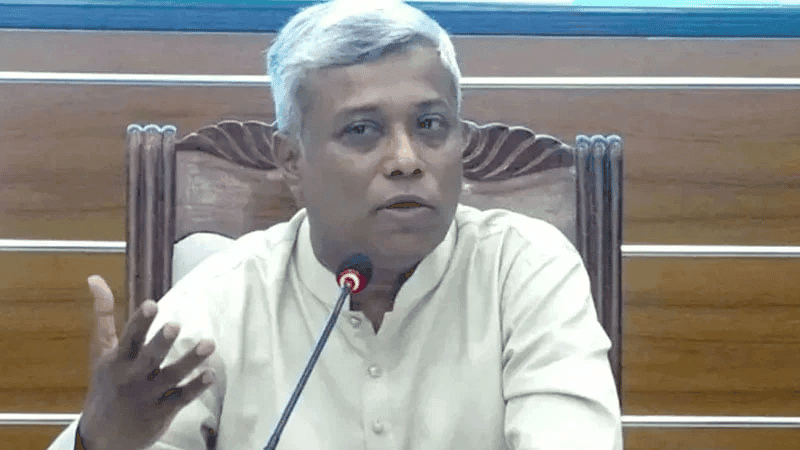

The current crisis in the country's power sector is a result of the previous government's flawed policies and contracts signed with private power plants in disregard of national interests, Power and Energy State Minister Anindya Islam Amit has said. He added that the current government is working with those inherited limitations, while aiming to generate at least 10,000 megawatts of electricity from renewable energy by the end of its term.
The state minister made the remarks at a press conference on the ongoing power situation at the Bidyut Bhaban's Bijoy Hall on Monday, July 6. Power Division Secretary Mirana Mahrukh and Bangladesh Power Development Board (PDB) Chairman Md Rezaul Karim were also present.
The state minister said while the country's peak demand is around 18,000 megawatts, production capacity stands at 29,000 to 30,000 megawatts. Even after accounting for a 20 per cent emergency reserve, approximately 12,000 megawatts of excess capacity remains idle. The government has been paying massive capacity charges year after year against this excess capacity, putting significant pressure on the national economy.
He further said the contracts signed by the previous government did not adequately safeguard state interests. However, as sovereign contracts, they cannot be unilaterally cancelled. Efforts are underway to renegotiate electricity tariffs through discussions. In the last month, prices have been revised in several cases.
Power Division Secretary Mirana Mahrukh said although the Power and Energy Supply (Special Provisions) Act, 2010 has been repealed, the old contracts will remain in effect. Cancelling a contract of a major power plant would immediately create a massive power shortage that would take four to five years to fill. Therefore, decisions must be made balancing supply and investment.
On load-shedding, PDB Chairman Md Rezaul Karim said while approximately 13,500 megawatts of demand is being met, grid constraints in Mymensingh and Gazipur areas are causing load-shedding in some areas. Despite production capacity, transmission weaknesses prevent power from reaching designated areas, forcing reliance on liquid fuel-based engine-driven plants that cannot run for 24 hours. However, Power Grid Company of Bangladesh (PGCB) is working to improve the transmission system.
On the recent inconvenience caused by long recharge codes of 100 to 200 digits for prepaid meters, the secretary said it was a technical complication arising from tariff changes. To avoid such problems in the future, necessary coordination with meter suppliers has been done in advance.
Leave A Comment