
Raw markets and small grocery stores will remain outside VAT: Finance Minister
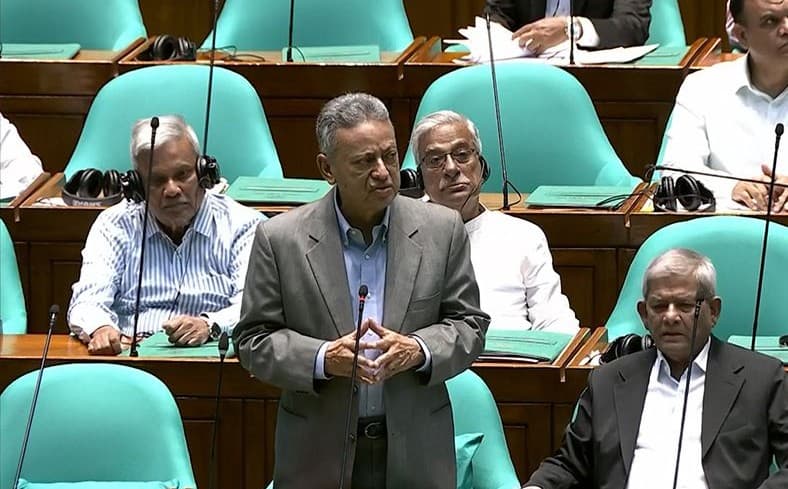

Finance Minister Amir Khasru Mahmud Chowdhury told the parliament that the revenue collection of the National Board of Revenue (NBR) has crossed the milestone of four lakh crore taka for the first time. He presented it as a historic success in the country's revenue management.
The Finance Minister mentioned that this dynamism in the revenue sector has come about due to various steps taken by the current government in just four months of assuming office. He said that although an initiative has been taken to pay VAT at a flat rate to stop harassment of small traders, raw markets and small grocery stores will be completely kept out of the scope of this VAT, keeping in mind the comfort of the common people.
He presented these information in his closing speech on the proposed budget for the 2026-27 fiscal year on the 18th day of the second and first budget sessions of the 13th National Parliament on Monday.
The Finance Minister said that although the revenue target set for the next fiscal year is challenging, it is possible to achieve it. The government wants to reach the revenue collection target by expanding the tax base rather than increasing tax rates. Making revenue management taxpayer-friendly and bringing transparency in revenue collection are among the government's top priorities. To this end, initiatives are being taken to promote business and commerce by ensuring transparency and accountability through separation of revenue policy and revenue management, automation of the tax system, prevention of tax evasion, and deregulation. For the convenience of small traders and to stop harassment, initiatives have been taken to pay VAT at a flat rate according to their ability, but he assured that raw markets and small grocery stores will remain outside the scope of this VAT.
Mentioning the various steps taken by the government to control inflation and restore peace in public life, Amir Khasru Mahmud Chowdhury said, "Initiatives have been taken to control the money supply in the market through effective coordination of monetary policy and fiscal policy. In addition, efforts have been made to strengthen foreign exchange reserves, stabilize the exchange rate of the taka, increase overall productivity including agriculture and industry, and reduce taxes at the source on 60 products to control the prices of essential goods. At the same time, strict measures are being taken to eliminate defects in the supply system, increase competition in the market, and against the artificial crisis and manipulation tendencies of dishonest circles, which will gradually bring inflation under control."
Regarding the estimated 6.5 percent GDP growth for the next fiscal year, the Finance Minister said, "Growth is not just a statistic, it is a reflection of the overall activities of the economy, investment, production, employment and confidence. To achieve this target, special emphasis is being given to increasing public-private investment, expanding the service sector including industry, agriculture and ICT, and all promising sectors. By bringing creative economy sectors into the mainstream, production capacity will be increased nationwide, human resource development, physical infrastructure development and the private sector will be strengthened, which will play a helpful role in achieving the growth target."
Expressing the government's firm determination to restore discipline in budget deficit and government expenditure management, he said that the budget deficit will be kept at a tolerable level through increasing efficiency in government expenditure and sustainable debt management. The government has taken initiatives to gradually reduce operating expenses and increase development expenditure. To that end, it has been proposed to increase the share of development expenditure in the budget from 27.27 percent in the 2025-26 fiscal year to 33.70 percent in the 2026-27 fiscal year. On the other hand, it has been proposed to reduce the operating expenditure from 72.73 percent in the 2025-26 fiscal year to 66.30 percent in the 2026-27 fiscal year. This share of development expenditure will be further increased and the share of operating expenditure will be gradually reduced in the coming fiscal years.
Leave A Comment