

Rawhide market crashes again as traders ignore government prices
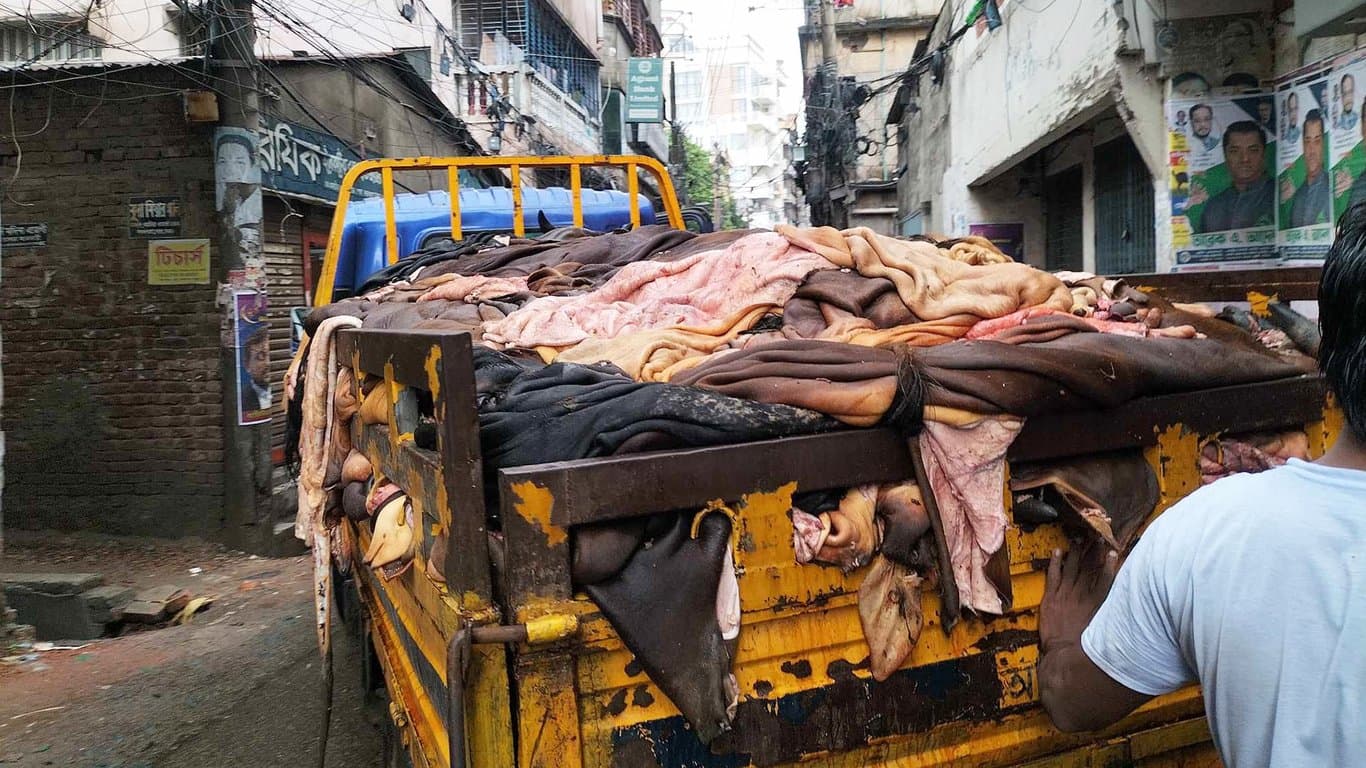

The sacrificial animal hide market witnessed another major collapse during Eid-ul-Azha this year, with tannery owners and major traders largely ignoring the prices fixed by the government, leaving seasonal traders, madrasas and orphanages facing heavy losses.
Although the government had set the price of salted cowhide in Dhaka at Tk 62 to Tk 67 per square foot — Tk 2 higher than last year — rawhides were sold at significantly lower rates in markets across the capital and other parts of the country.
Seasonal traders said they had to sell each hide at Tk 150 to Tk 200 less than last year’s prices, while demand for goat skins remained extremely poor.
Traders and industry insiders said seasonal collectors largely depend on tannery owners and large wholesalers, forcing them to buy and sell hides at low prices dictated by the market.
Visits to the capital’s largest rawhide market at Posta in Lalbagh showed that traders failed to receive government-fixed prices despite bringing large quantities of hides to the market on Thursday evening.
Many alleged that although authorities announce prices every year ahead of Eid, effective market monitoring remains absent, allowing influential traders and tannery owners to control prices through syndicates.
Industry insiders said preserving a single rawhide costs around Tk 300 to Tk 350, including salt, labour and transportation expenses. However, most hides are being sold at less than half the expected market value based on government rates.
Seasonal trader Akmal Hossain, who brought 20 cowhides to the Posta market, said he sought Tk 1,000 per hide but wholesalers were unwilling to offer more than Tk 650.
“Last year, I sold similar hides for Tk 800 to Tk 900. This year, nobody wants to pay more than Tk 600 to Tk 650 despite the government increasing prices,” he said.
Similar conditions were observed in Mohammadpur, Malibagh, Moghbazar, Mugda, Dhanmondi, Kolabagan, Science Lab and Shewrapara areas of the capital.
Small cowhides were sold for Tk 250 to Tk 450, medium-sized hides for Tk 500 to Tk 650 and large hides for Tk 700 to Tk 900, far below the government’s expected rates of Tk 1,300 to Tk 1,850 for medium hides and over Tk 2,000 for larger ones.
Seasonal traders alleged that tannery owners did not offer prices in line with the government’s declared rates, causing losses not only for traders but also for mosques, madrasas and orphanages that depend heavily on hide sales for funding.
Goat skin prices also collapsed, with some skins sold for as little as Tk 5 to Tk 10, while in many cases traders reportedly collected them without paying any price at all.
Many traders said goat skins had become a burden because the sale proceeds were insufficient even to cover preservation costs.
Madrasas and orphanages, which collect large numbers of sacrificial hides every year through donations, are among the worst affected by the continuing market instability.
Administrators of these institutions said income from hide sales plays a crucial role in operating orphanages, boarding facilities and educational programmes for underprivileged students.
Mahbubullah, principal of Nazmul Haque Madinatul Ulum Kamil Madrasa in Khilgaon, alleged that the leather sector was being “systematically destroyed” every year and warned that religious educational institutions would face greater financial hardship if fair prices were not ensured.
Leave A Comment
You need login first to leave a comment