

Rohingya repatriation not possible now due to Myanmar conflict: Foreign Minister
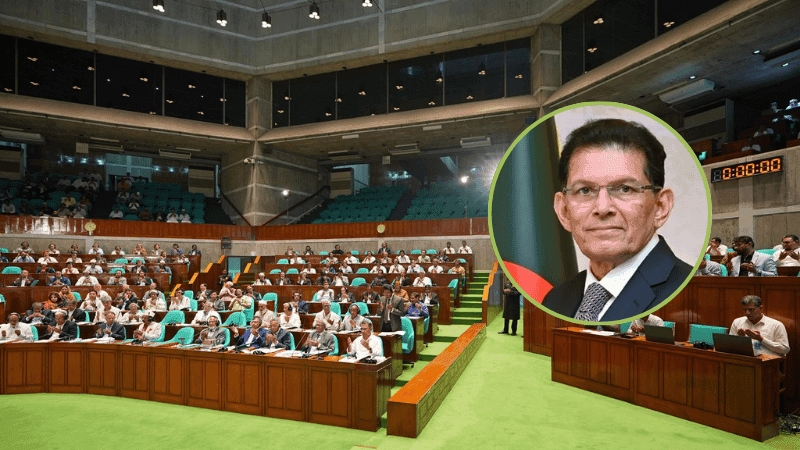

Rohingya repatriation cannot begin at this moment due to the ongoing conflict in Myanmar, Foreign Minister Dr Khalilur Rahman told parliament on Monday, March 30.
He made these remarks during a question-and-answer session in the parliamentary session chaired by Deputy Speaker Barrister Kayser Kamal, which began at 3:30 pm. In the absence of the Foreign Minister, State Minister for Foreign Affairs Shama Obaed Islam responded to questions from MPs.
Responding to a question from Jamaat MP Shahjahan Chowdhury from Chattogram-15, Foreign Minister Dr Khalilur Rahman stated that Bangladesh has undertaken multifaceted diplomatic and international initiatives aimed at finding a sustainable solution to the Rohingya crisis. He said despite the current internal instability and conflict in Myanmar, the present government will take effective measures to handle the situation based on past experience. The government's position is clear: the only sustainable solution to the Rohingya crisis is safe, voluntary and dignified repatriation. To this end, Bangladesh will continue all diplomatic, legal and humanitarian efforts while strengthening international cooperation and support.
Noting that the BNP successfully facilitated Rohingya repatriation in two phases in 1978 and 1992, he further said Bangladesh is regularly conducting Rohingya data verification with the Myanmar government for repatriation. Bangladesh has so far sent information on 829,036 Rohingya to the Myanmar government in six phases. Of these, Myanmar authorities have verified 354,751 individuals (as of January 2026). Among the lists sent by Bangladesh, Myanmar has identified 253,964 individuals as 'persons who previously resided in Myanmar'.
The Foreign Minister said Bangladesh has provided moral and diplomatic support to international judicial processes to ensure accountability. A case against Myanmar for organising genocide crimes against Rohingya is pending before the International Court of Justice (ICJ) in The Hague, Netherlands. Bangladesh has decided to provide financial assistance to support the conduct of the Gambia v. Myanmar case. Bangladesh is closely monitoring this legal process and supporting ongoing initiatives to establish international justice.
In response to a question from MP A E Sultan Mahmood Babu from Jamalpur-2, Dr Khalilur Rahman said the government has taken integrated steps to protect national interests through expanding export markets, increasing foreign investment and successful application of diplomacy in light of the government's election pledges.
He stated the government is working to explore new markets for Bangladeshi products beyond traditional markets such as Europe and America. Commercial ties are being strengthened with emerging economies in the Middle East, Africa, South America, Southeast Asia and Eastern Europe. Discussions are underway on the possibility of signing bilateral trade agreements, preferential trade arrangements (PTA) and free trade agreements (FTA) with promising countries, which would help expand export markets and strengthen bilateral relations when implemented.
Noting that diversifying export products is a pledge of the current government, the minister said the government is focusing on developing a multi-dimensional export structure with a wider range of exportable products to reduce the long-standing over-reliance on the readymade garment sector for export earnings.
Dr Khalilur Rahman said embassies have strengthened diaspora engagement activities to involve expatriate Bangladeshi entrepreneurs and investors in the country's economic development.
Describing export trade expansion and economic diplomacy as an ongoing process, he said the Ministry of Foreign Affairs is working tirelessly, in coordination with other ministries and agencies, to accelerate the process.
In response to a question from MP Mohammad Fakhrul Islam from Noakhali-5, the Foreign Minister said a significant policy shift in foreign policy under the current government is maintaining international relations prioritising national interests. "We are conducting foreign policy based on national sovereignty, territorial integrity, non-interference in internal affairs of other countries, and mutual respect and interests. In the context of the Middle East conflict, the fact that both GCC countries and Iran consider Bangladesh a friendly nation is a primary outcome of our balanced foreign policy."
In response to a supplementary question from Jamaat MP Mir Ahmad Bin Qasim, State Minister for Foreign Affairs Shama Obaed said there is no fuel crisis in Bangladesh. The Prime Minister has held meetings with multiple ministries to import fuel from various sources. Efforts are ongoing to import fuel from alternative sources beyond the Middle East, and success will be achieved.
Leave A Comment
You need login first to leave a comment