
Rooftop solar systems at DC, divisional offices to generate 5.07 MW electricity
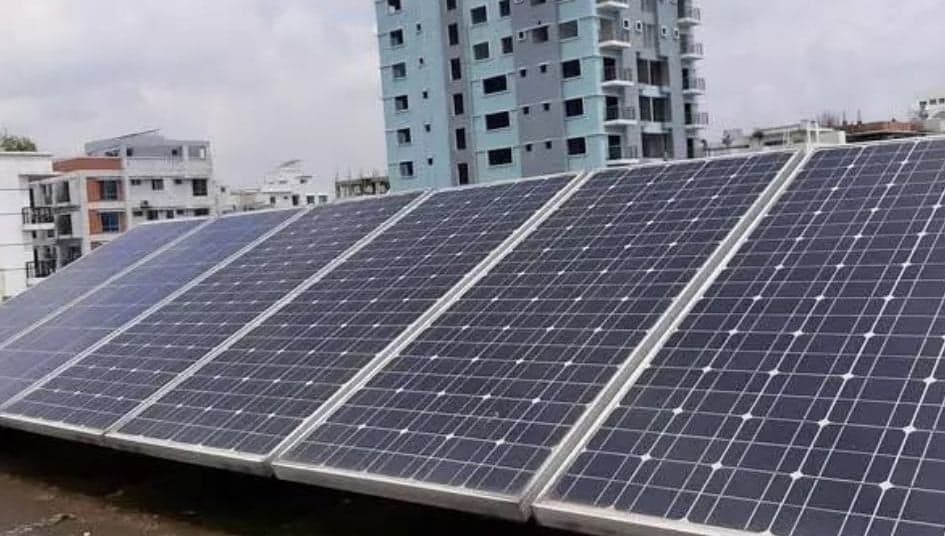

Rooftop solar power systems installed at deputy commissioner (DC) offices and divisional commissioner offices across Bangladesh have a combined capacity of generating 5.07 megawatts power, offering scopes to reduce electricity bills and dependence on the national grid once all systems become fully operational and net metering is introduced.
According to a progress report on the installation of rooftop solar systems on government buildings, DC offices had a combined capacity of 4,663 kilowatts as of June, while five divisional commissioner offices had a capacity of 405.5 kilowatts.
The government has spent about Taka 15.15 crore on the initiative.
Officials said solar systems have already been installed on government office rooftops, but some administrative procedures, including approval for net metering, remain pending. Once completed, the systems will be able to deliver greater financial savings, while surplus electricity could be supplied to the national grid.
Under net metering, excess electricity generated by a solar installation can be fed into the grid, allowing eligible consumers to receive adjustments to their electricity bills.
Among the district offices in Dhaka Division, Kishoreganj has the highest generation capacity at 360 kilowatts, followed by Manikganj at 77 kilowatts and Gopalganj at 73 kilowatts. The total expenditure in the division was Taka 2.8 crore.
In Khulna Division, Khulna district leads with 180 kilowatts, followed by Meherpur with 80 kilowatts. The division spent about Taka 2.7 crore on district offices, while a 200-kilowatt system at the divisional commissioner's office cost Taka 79 lakh.
In Rangpur Division, Dinajpur has 151 kilowatts capacity and Gaibandha 122 kilowatts. Expenditure on district offices totalled Taka 2.08 crore, while the 77.5-kilowatt system at the divisional commissioner's office cost Taka 37 lakh.
Rajshahi Division has installations in all eight districts listed in the report, led by Sirajganj with 150 kilowatts, Naogaon with 105 kilowatts and Bogura with 100 kilowatts. District-level expenditure stood at nearly Taka 2.49 crore.
In Sylhet Division, Moulvibazar has 180 kilowatts, Sylhet 100 kilowatts and Sunamganj 90 kilowatts. The expenditure on district offices was Taka 1.54 crore.
Noakhali leads Chattogram Division with 225 kilowatts, followed by Cox's Bazar with 85 kilowatts. District offices in the division accounted for about Taka 1.29 crore in expenditure.
In Barishal Division, Barguna has 60 kilowatts, while Pirojpur, Patuakhali and Jhalakathi each have 50 kilowatts. Jamalpur and Netrokona in Mymensingh Division each have 100 kilowatts, followed by Sherpur with 60 kilowatts and Mymensingh district with 50 kilowatts.
The expenditure figures for Mymensingh Division were unavailable.
The report said no solar system could be installed at the Mymensingh divisional commissioner's office because it operates from a rented building. Capacity and expenditure details for the Dhaka and Chattogram divisional commissioner's offices were also unavailable.
Implementation has faced other obstacles. Although tenders were invited in Tangail, Madaripur, Narsingdi and Narayanganj, installations could not be completed. In Chuadanga in Khulna Division, the proposed tender price exceeded the allocated budget.
The experience of Shariatpur district administration illustrates the benefits and remaining challenges. The office has a 24-kilowatt rooftop solar system and requires about 5,000 units of electricity each month.
According to the West Zone Power Distribution Company Limited (WZPDCL), the installation has been generating around 800 units monthly, reducing the office's need for grid electricity. However, the net-metering application remains under process, preventing bill adjustments for surplus power.
Shafiqul Alam, lead analyst at the Institute for Energy Economics and Financial Analysis (IEEFA), told BSS that although the combined capacity of more than five megawatts would not make a major contribution at the national level, effective operation could set an example for rooftop solar expansion across public and private buildings.
He stressed the need to promote rooftop solar among commercial establishments and rural communities, while urging authorities to avoid delays in providing net-metering connections.
Installation and grid-connection procedures should progress in a coordinated manner, he said.
Meherpur Deputy Commissioner (DC) Shilpi Rani Roy said an 80-kilowatt solar system had been installed at her office under the government initiative.
Expanding rooftop solar generation could ease pressure on the national grid and help meet rising electricity demand, she said, adding that renewable energy would be important for strengthening energy security.
The government has adopted the Renewable Energy Development Strategy 2026-2030, prioritising renewable energy in its election manifesto. The strategy sets a target of 10,500 megawatts of renewable generation capacity by 2030, including 5,500 megawatts from rooftop solar power.
According to the latest data from the Sustainable and Renewable Energy Development Authority (SREDA), Bangladesh has 1,935 megawatts of installed renewable energy capacity, of which solar power accounts for 1,642 megawatts.
The government's rooftop solar programme at administrative offices is a relatively small component of that national capacity, but officials and energy analysts say completing installations and resolving net-metering delays could improve its contribution to electricity savings and wider renewable energy adoption.
Leave A Comment