
Teacher’s dismissal without education board approval illegal: HC
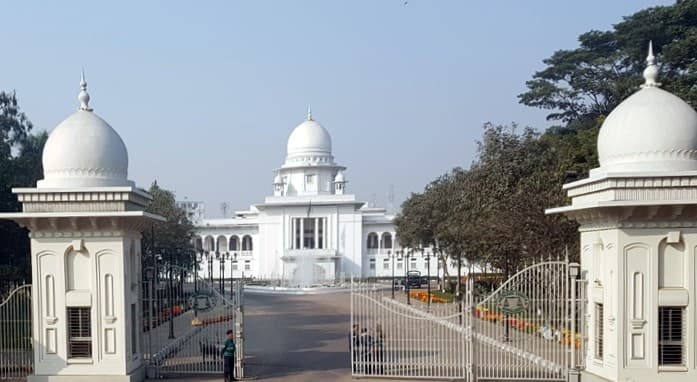

The High Court has ruled that dismissing a teacher solely on the decision of a governing body, without prior approval from the education board’s Appeal and Arbitration Committee, is illegal.
The court also said forming an investigation committee solely on the basis of a telephone instruction from the chairman of a governing body, bypassing the prescribed legal procedure, is completely unlawful.
The ruling was delivered on Jul 9 by a High Court bench comprising Justice Md Shohrowardi and Justice Justice Dihider Masum Kabir while disposing of a writ petition challenging the decision to dismiss Md Abul Mansur, an assistant professor in the mathematics department of Gachihata College in Katiadi Upazila of Kishoreganj.
Md Kamruzzaman represented the petitioner in court, while Md Zahirul Islam represented the teacher.
Deputy Attorney General Md Anisur Rahman Khan and Sultan Mahmud Banna represented the state.
In 2014, allegations were brought against Assistant Prof Mansur that on Nov 9, he had gone to the residence of Zakia Begum, head teacher of Gachihata Palli Academy, and behaved indecently with her younger daughter with an improper intention.
Following the allegation, the college principal served him a show-cause notice on Nov 17.
The notice mentioned Nov 7 as the date of the alleged incident and asked him to respond within three days.
As his response was deemed unsatisfactory, a second notice was issued on Nov 29. In his reply submitted on Dec 6, the teacher again denied the allegations.
Subsequently, a three strong probe committee was formed on Dec 7 following a verbal or telephone instruction from the chairman of the governing body, Md Akhtaruzzaman.
Based on the investigation report, the governing body decided at its meeting on Jan 31, 2015, to dismiss the teacher, showing the dismissal as effective from Feb 1.
The decision was later sent to the Appeal and Arbitration Committee of the Dhaka board on Feb 16, for approval.
At its meeting on Apr 20, the committee rejected the dismissal and ordered that the teacher be reinstated with payment of his outstanding salary and allowances.
As there was no legal scope for reviewing the decision, governing body chairman Akhtaruzzaman filed a writ petition with the High Court challenging the board’s order.
After the final hearing, the court dismissed both the rule and the stay order.
In its observations, the High Court said that the prescribed legal procedure must be followed step by step when dismissing a teacher of a recognised private college.
If allegations of misconduct are raised, the teacher must be served with a written notice and given at least seven days to provide an explanation.
The notice must also mention the proposed punishment and ask whether the teacher wants a personal hearing.
If the teacher seeks a personal hearing, a three-member probe committee must be formed, the court said in its ruling.
The court said that an investigation committee must be formed through a formal resolution adopted at a duly convened meeting of the governing body.
A verbal or telephone instruction from the chairman of the governing body or anyone else cannot serve as a substitute for a formal resolution.
In the case under consideration, the court described the formation of the committee by telephone as a clear violation of the legal procedure, according to the ruling.
The court also found a major discrepancy in the dates of the alleged incident mentioned in the case documents.
While the original allegation stated Nov 9, the first notice mentioned Nov 7, and the investigation report referred to Dec 5.
Furthermore, the teacher was not examined before the investigation committee, and the committee was given six days instead of seven days to submit its report.
The court said that restricting the opportunity for the teacher to defend himself violated the principles of natural justice.
The ruling stated that a governing body cannot directly dismiss a teacher; it can only make a proposal for dismissal.
Approval from the education board’s Appeal and Arbitration Committee is required before the dismissal can take effect.
However, in this case, the dismissal was made effective from Feb 1, while the matter was sent to the board for approval only on Feb 16.
The court said that the governing body cannot treat the board’s mandatory approval merely as a formality or a “rubber stamp”.
The ruling stated that the Apr 20, 2015 decision of Appeal and Arbitration Committee—cancelling the decision of the governing body of Gachihata College, reinstating the teacher to his post, and ordering payment of his outstanding dues—was entirely proper and lawful.
The ruling noted that, as the teacher Abul Mansur reached the retirement age while the case was pending, he could no longer be reinstated to his previous position.
However, the court observed that he was entitled to receive his outstanding salary, employment-related benefits, and applicable pension benefits up to the date he reached retirement age.
As the court found no legal basis for the petition, it dismissed the rule.
Leave A Comment