
UGC Chairman calls for clear rules on AI use in universities
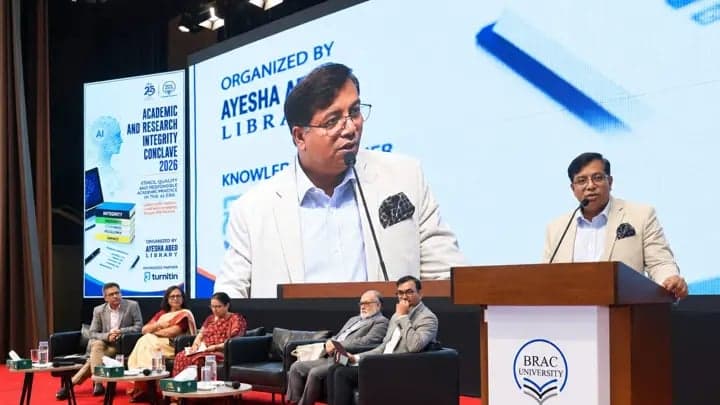

University Grants Commission (UGC) Chairman Professor Mamun Ahmed has called on universities to introduce clear policies governing the use of artificial intelligence in education and research, including when AI may be used, when it should be prohibited and when its use must be disclosed.
Speaking at the Academic and Research Integrity Conclave 2026 at BRAC University on Wednesday (September 9), Ahmed said universities could introduce an “AI disclosure statement” requiring students and researchers to state which AI tools they used, for what purposes and how AI-generated information was verified.
He also urged universities to rethink assessment methods as AI becomes increasingly embedded in academic work. Rather than relying solely on software to detect AI-generated assignments, institutions should assess how students learn, think and develop their work, he said.
He suggested oral explanations of assignments, retaining research drafts and supporting documents, field-based data collection and real-world problem-solving exercises as ways to verify students’ learning and contribution.
Ahmed outlined four key measures to strengthen academic integrity and address AI-related misconduct: developing clear AI-use policies; prioritising research quality over publication volume in academic promotions; introducing mandatory courses on research integrity and proper citation; and strengthening technological capacity to detect plagiarism and inappropriate AI use in research.
He warned that the pressure to increase publication numbers was encouraging some researchers to publish in low-quality journals. One high-quality and significant research paper, he said, could be more valuable than five inferior publications.
Ahmed also highlighted the risk of fabricated data and misinformation generated with AI, calling for stronger institutional oversight and accountability.
He stressed that students should be introduced to research ethics at the undergraduate level. He proposed a mandatory course on research integrity and proper citation for every student before graduation, regardless of discipline, alongside a national framework covering plagiarism, authorship, data management, ethical approval, conflicts of interest, research supervision and the ethical use of AI.
Rather than banning AI, Ahmed said universities should equip teachers and students to use the technology responsibly and ethically. AI can accelerate education and research, he noted, but it can also produce inaccurate information, faulty citations and biased results. Large language models cannot be held accountable for their outputs, he said, leaving users ultimately responsible for the results they produce with AI.
The conclave was attended by university vice-chancellors, researchers and academics, with speakers including BRAC University Board of Trustees member Rasheda K Chowdhury, Dhaka University Emeritus Professor A.F.M. Yusuf Haider, Turnitin South Asia Director Chaitali Mitra and BRAC University Vice-Chancellor Professor Arshad Mahmud Chowdhury.
Leave A Comment