
Widespread reaction over Bangladesh Betar's 'dress code' directives
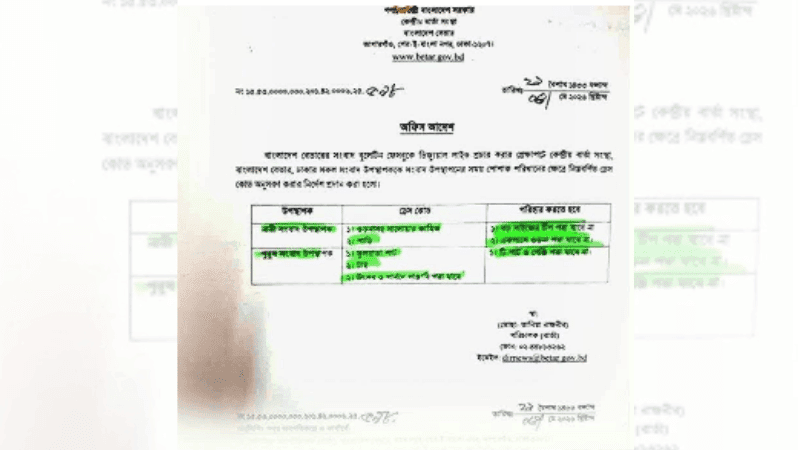

Bangladesh Betar's new dress code guidelines for Facebook Live news presenters have sparked widespread discussion and criticism on social media platforms. Recently, a picture of an office order issued by Bangladesh Betar's news department went viral online. It gave specific instructions on the attire of female and male news presenters.
The directive that was circulated said that female presenters should not wear 'big bindis', 'orna on one-side', 'T-shirts' and 'genjis'.
On the other hand, there is a ban on wearing 'genjis' and 'round neck T-shirts' for male presenters. The directive was mainly issued to keep the presenters' attire and presentation more 'decent and appropriate' while reading the news on Facebook Live, the office order stated.
However, there have been mixed reactions on social media. Many see the dress code guidelines for presenters in state-run media as 'extra control'. Some have raised questions that the main focus of news presentation should be news and professionalism, not clothing. Many have also commented that giving separate instructions on clothing to female presenters in particular is 'gender-discriminatory'.
Nuzia Hasin Rasha, Economic Affairs Secretary of the Dhaka University branch of the Revolutionary Students' Alliance, said that women in Bangladesh have been subjected to social harassment and attacks many times over wearing a headscarf or headscarf. In such a reality, bringing these issues under control by a state-owned institution indirectly legitimizes that discriminatory mentality, legitimizes harassment. The restrictions imposed on large headscarves or headscarves are not free from the influence of religious conservative thinking.
She also said that women in the journalism profession still face various types of gender discrimination, harassment and professional obstacles. Instead of focusing on solving those structural problems, making clothing and personal grooming a matter of control is a misguided priority and a worrying trend that is narrowing women's independent professional identity.
Writer and human rights activist Ferdous Ara Rumi said that an institution can fix a dress code. But if it fixes it only for women, then that is problematic. Because it is discriminatory against women. By fixing women's clothing, there is a direct interference in their freedom of choice of clothing.
Stating that the tips or bindis is in no way contradictory to the dress code, she said that no one can decide who will wear what, where to put the veil.
Rumi also said that the responsibility of protecting decency, religion, culture, etc. has been imposed on women alone for ages, which is a manifestation of a very patriarchal mentality and through this, women's movement, activity, and spontaneity are hindered. Through all this, the patriarchal structure wants to suppress women.
Nadira Yasmin, editor of 'Nari Angan', said, 'Women are already almost powerless in the context of Bangladesh. When a national media outlet wants to control women's choice of clothing and grooming, it officially reduces women's power and marginalizes them. Moreover, through this, other organizations will also be given the opportunity to impose various restrictions on women unannounced. I hope that Bangladesh Betar will come out of such anti-women's freedom decisions. Otherwise, we women's organizations will jointly build strong resistance against Bangladesh Betar.'
No official detailed explanation has been received from Bangladesh Betar on this matter yet.
Leave A Comment