
Women's forums demand quick formulation of tobacco control law rules
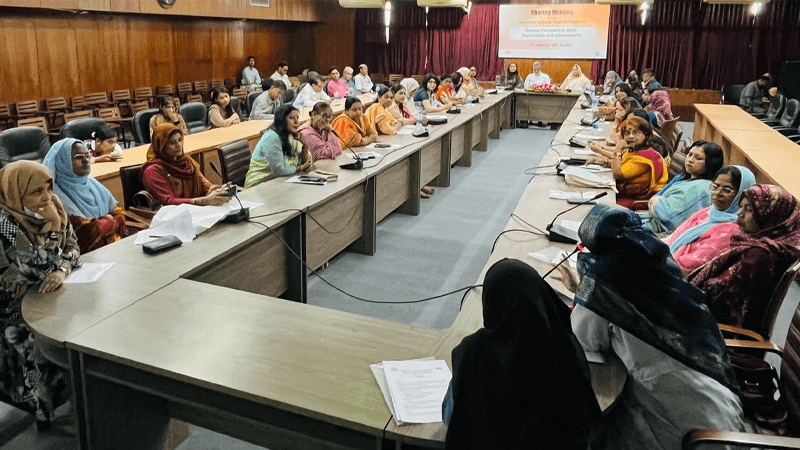

Members of the Women's Forums Against Tobacco have demanded the formulation of rules at the earliest possible time to make the amended tobacco control law effective. In their view, delaying the framing of rules after the passage of the law could hinder its effective implementation.
The demand was made at a discussion meeting titled 'Tobacco Control Amended Act 2026: Expectations and Achievements', organised by Nari Maitree at the Bangladesh Shilpakala Academy on Sunday, September 27.
The speakers thanked the government for passing the Smoking and Tobacco Products Usage (Control) Act, 2005 (Amended 2026) during the first session of Parliament. At the same time, they emphasised the early formulation of rules to make the provisions of the law effective.
The meeting was informed that Bangladesh is one of the countries with a high prevalence of tobacco use. Among South Asian countries, Bangladesh has the highest tobacco-use prevalence at 35.3 percent, compared with 28.6 percent in India and 19.1 percent in Pakistan. According to the Global Adult Tobacco Survey (GATS), 2017, approximately 3.78 crore adults in Bangladesh currently use tobacco.
Citing the Tobacco Atlas 2025, the meeting was informed that around 200,000 people die every year in Bangladesh from diseases caused by tobacco use. Additionally, several hundred thousand more suffer disabilities.
According to recent research by the Institute of Health Economics at the University of Dhaka, government revenue from the tobacco sector in fiscal year 2024-25 was around Tk 41,000 crore. In contrast, the annual economic loss caused by tobacco use, including deaths, health and environmental damage, is around Tk 87,000 crore, the meeting was informed. In other words, the economic losses caused by tobacco use are more than twice the revenue generated from the sector.
The speakers said the passage of the Smoking and Tobacco Products Usage (Control) Act, 2005 (Amended 2026) on April 10 was an important step in tobacco control. However, equal importance must be given to formulating rules for its implementation after the law's passage.
Newaz Halima Arly, MP, said the present government is committed to protecting public health from the harmful effects of tobacco. By enacting the amended tobacco control law, the government has established the necessary policy foundation. Now, the initiative needs to be taken forward by formulating the rules quickly.
She said a committee has already been formed to facilitate the formulation of the rules. She called on the relevant authorities to expedite the process of formulating the rules on a priority basis.
Farida Yasmin, MP, said Bangladesh signed the WHO Framework Convention on Tobacco Control in 2003, the world's first international public health treaty on tobacco control. However, some important aspects of that convention have still not been fully reflected in the amended tobacco control law.
In her view, issues such as protecting public health policy from the influence of the tobacco industry, regulating the contents and emissions of tobacco products, public awareness and support for quitting tobacco need to be considered with greater importance. She called for taking into account the obligations and implementation guidelines of the international convention while formulating the rules.
Helen Zerin Khan, MP, said some important limitations remain in the amended law. Issues such as regulating new types of nicotine and tobacco products, including e-cigarettes and heated tobacco, and controlling the sale of loose cigarette sticks and open tobacco products, have not been adequately included.
She said these products, in particular, could increase the risk of tobacco and nicotine use among young people. The sale of loose cigarette sticks is making tobacco products easily accessible to young people. Therefore, effective measures must be ensured by taking these issues into consideration while formulating the rules.
Salina Sultana, MP, said the amended law allows designated smoking areas to be maintained in public places and public transport under certain conditions. The rules must contain clear and effective directives to ensure that tobacco companies cannot exploit this provision through various tactics.
The meeting was chaired by Shahin Akter Dolly, Executive Director of Nari Maitree. Members of the Mothers' Forum Against Tobacco, Teachers' Forum Against Tobacco, Women Journalists' Forum Against Tobacco and Youth Forum Against Tobacco were present. They also demanded that the tobacco control framework be made clearer and stronger through the formulation of effective rules quickly.
Leave A Comment