
When justice has to be snatched away (Part 2)
30 years of Yasmin tragedy
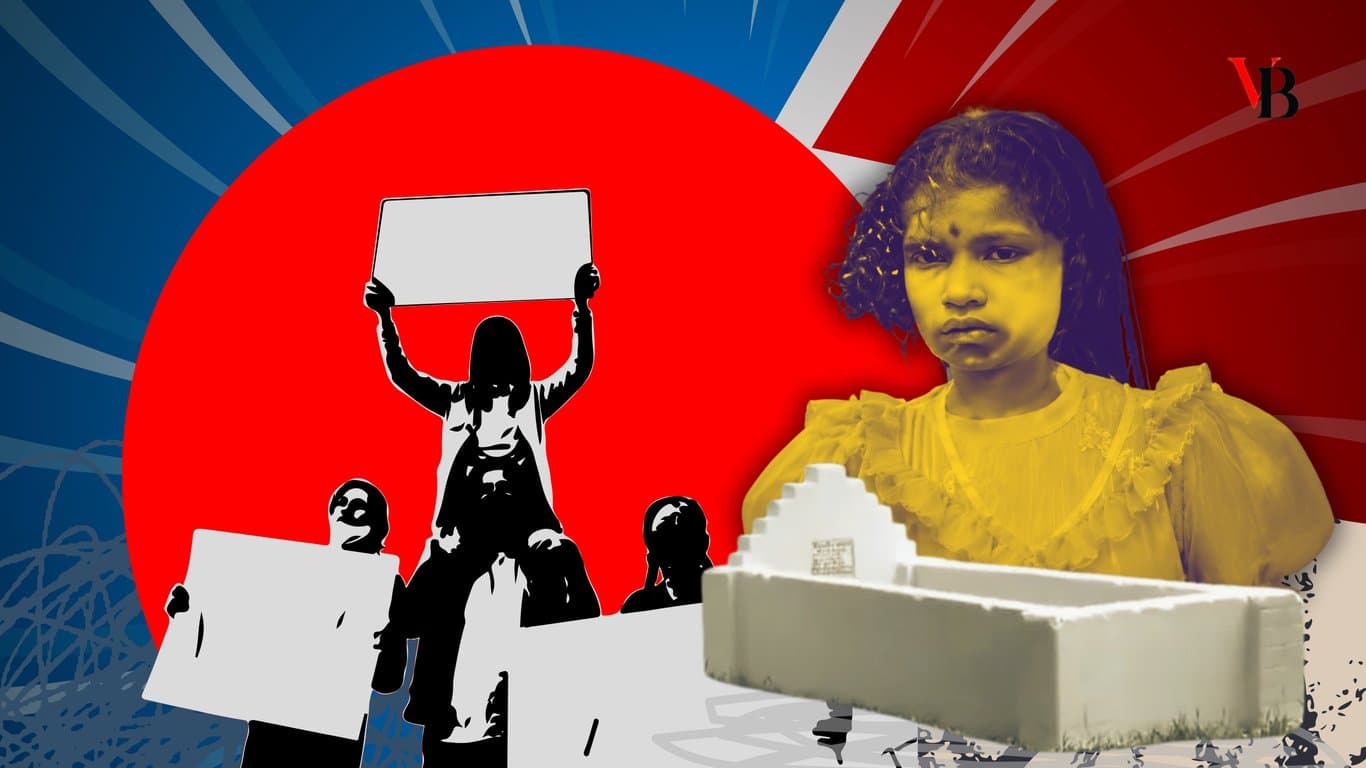

Three decades later: The circle still turns
Three decades after Yasmin’s murder, the crisis against which Dinajpur rose up has not disappeared; rather, in some respects, it has returned with an even more frightening face. A particular piece of information from the Bangladesh Mahila Parishad’s “Violence Against Women and Girls: 2025 Survey” is especially heart-wrenching: according to the survey, girls aged six to nine are at the highest risk among child victims of rape. At an age when a child should be holding a doll in her arms, she is instead becoming a victim of brutality. There can be no deeper social shame than this. According to the organisation’s latest figures, in just the first five months of 2026 (January to May), 1,035 women and girls were victims of violence, including 250 rape victims, 65 victims of gang rape, and 18 who were raped and then killed. And these figures represent only incidents reported in newspapers; it is easy to assume that the actual number of unreported and suppressed cases is many times higher.
A government survey also gives a frightening indication of this invisible spread. According to the findings of the “Violence Against Women Survey 2024,” conducted by the Bangladesh Bureau of Statistics with the support of the United Nations Population Fund, around 76 percent of the women who participated in the survey had experienced some form of violence or controlling behaviour by an intimate partner at least once in their lives. Most painfully, a large proportion of the victims never told anyone about it. This silence is not driven by fear alone. Behind it lie social stigma, economic helplessness, the prolonged process of litigation, and the fear of being harassed for seeking justice. In other words, women’s safety is not merely a question of law and order; it is simultaneously a question of economics, society and access to justice.
Most tragic of all is that the same circle that emerged from the Yasmin incident is still turning today; only the names and faces of the victims have changed. In March 2025, an eight-year-old girl in Magura was raped and murdered. According to a RisingBD report, amid nationwide protests over the incident, the government hastily issued the “Women and Children Repression (Amendment) Ordinance, 2025,” which stipulated that rape cases must be concluded within 90 working days of the framing of charges and provided for separate tribunals for child rape cases. From Yasmin to Magura, the pattern of events is almost identical: a horrific crime, followed by national outrage, followed by a hurried response from the state. In thirty years, this pattern has not changed; only the face of the mother who has lost her child has changed.
Post-August 2024 statistics: A deeper crisis
The most worrying recent trend emerges in the period following the political changeover in August 2024. Statistics from multiple independent sources are delivering the same message: violence against women and children has not declined; rather, it has increased across almost every measurable indicator.
According to Police Headquarters data, 21,939 cases were filed across the country in 2025 over allegations of violence against women and children. Compared with 2024, cases of violence against women increased by around 25 percent, while rape cases increased by around 27 percent. According to one report, law-enforcement statistics show that more than 7,000 rape cases were filed across the country in 2025 alone. And according to High Court data, at the end of last year, more than 132,000 cases were pending before the country’s 99 Women and Children Repression Prevention Tribunals, a huge portion of which were more than five years old. This mountain of impunity silently encourages violence.
According to a year-end report by Bangladesh Pratidin, 94 people were victims of attempted rape in 2024, while the figure nearly doubled to 181 in 2025. The number of victims who were raped and then murdered rose from 23 in 2024 to 29 in 2025.
According to an analysis by the Bangladesh Mahila Parishad, rape increased by around 60 percent in the first seven months of 2025 compared with the same period in 2024.
Child marriage also increased sharply during the same period: while 20 child marriages were documented throughout 2024, the number reached 61 in just the six months from January to June 2025—nearly three times as many.
Monthly monitoring by the Manabadhikar Shongskriti
Foundation (MSF) shows the same upward trend: while 54 incidents of rape were recorded in April 2026, the number rose to 78 in May, an increase of around 44 percent in a single month.
Whatever the source, the direction of the trend is consistent across independent monitoring, and that is what is most concerning. If women’s safety remains weak within the state structure regardless of the government or ruling period, it is not merely the failure of any particular political side; rather, it is evidence of a persistent institutional crisis. A recent comment by Monoranjan Shil Gopal, one of the leaders of the Yasmin movement, captures this pain.
He said, “The objective of the Yasmin movement has still not been achieved; women are still not safe.”
Quite reasonably, some may argue that this assessment is overly pessimistic. They may point out that there has been significant progress over the three decades since Yasmin: violence against women is now far more visible and widely discussed in society; a specific law, the Women and Children Repression Prevention Act, 2000, has been enacted; forensic mechanisms such as DNA testing have been introduced; and rapid verdicts in cases such as the Magura incident demonstrate that justice can be delivered faster than before. These arguments are not without merit.
Compared with Yasmin’s time, at least a minimum legal and institutional framework now exists, which did not exist then; the language and scope of protest have also expanded.
But this progress has a cruel limitation. The most important indicator is whether an ordinary, non-“viral” case also receives swift and certain justice. This is precisely where the deficiency becomes stark. Experienced figures in women’s rights and the legal arena have repeatedly pointed to this reality.
Former Justice Krishna Debnath, for example, has reminded us that justice must be ensured for all forms of violence against women and children, beyond high-profile or viral cases. Reactive lawmaking and institutional reliability are not the same thing. If the system only moves when the intensity of an incident generates sufficient pressure in the media and on the streets, then it must be understood that accountability has still not become the rule; it remains the exception. From Yasmin to Magura, this long and bloody continuity tells us exactly that.
The expectation behind carrying out the highest punishment in the Yasmin case was that exemplary punishment would deter future crimes. The statistics three decades later at least partly call that expectation into question. A well-known observation in criminology is that the certainty of punishment is more effective in controlling crime than the severity of punishment.
When exemplary sentences are occasionally handed down in high-profile cases, while most ordinary cases face prolonged delays and impunity, the message that reaches a potential offender may instead be that the likelihood of being caught and punished is actually low.
Therefore, rather than merely making punishments harsher, ensuring impartial investigation and certain justice in every complaint can become more effective as a long-term deterrent.
Particularly concerning are cases in which the perpetrator is connected to state or institutional power. The Yasmin case became so difficult to bring to justice precisely because the accused were police officers; even today, justice for crimes involving people connected to power remains comparatively slow and uncertain. Ensuring swift and equal justice regardless of the perpetrator’s political or institutional identity—in other words, allowing no special exemption for anyone in the justice system—is the most important and perhaps the least followed lesson of the Yasmin chapter.
A question also remains when we consider Yasmin’s identity. Three decades later, domestic workers, one of whom Yasmin was, still remain outside the full protection of labour laws. The work performed within the four walls of a home remains largely invisible, undocumented and beyond supervision, leaving this group particularly vulnerable to abuse. The true measure of a society’s safety structure can be assessed by the security of its most marginalised citizens, where protection is weakest. Yasmin repeatedly brings us back to precisely this standard.
Conclusion: From Remembrance to Change
Every year on 24 August, we wear black badges, lay flowers at memorials and attend discussion meetings. These rituals have value, but they are by no means sufficient. When observance of a day becomes a substitute for genuine reform, it can create a kind of social comfort and dull our sense of duty. True respect for Yasmin lies not merely in remembering her, but in making the structural changes that will ensure that no teenage girl in the future has to depend on the blood of an entire community to obtain justice.
This change must take place on two levels. First, in our social mentality, where the culture of blaming victims and the tendency to view women with suspicion rather than respect remain deeply rooted.
Second, in the state system, where police accountability, impartial investigation, swift and equal justice, and protection for victims must function not under the pressure of a particular incident, but as an ordinary part of everyday institutional practice. Without the combination of these two, this deep wound cannot be healed simply by making laws stricter or increasing punishments.
Yasmin has placed a mirror in our hands, not a monument. The face of our present is reflected in that mirror. If that face is still distorted by rape statistics, endless delays in justice and suspicion towards victims, then we must understand that Yasmin’s struggle is not yet over. The day that will truly serve as her memorial will be the day when no special day will be needed to demand justice for the death of another girl; the day when justice becomes the state’s quiet and ordinary habit, rather than something that must be snatched away at the cost of a grieving community’s blood. Yasmin, the girl who simply wanted to return safely home to her mother, wanted nothing more than that small yet sacred wish. Fulfilling that wish on behalf of all girls will be the greatest tribute we can offer her.
Part-1
30 Years of the Yasmin Tragedy
Leave A Comment